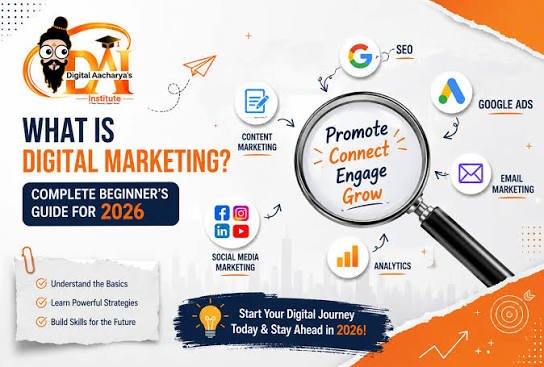
Digital marketing has become an important part of how businesses connect with customers, promote their products, and grow online. From search engines and social media to email campaigns and online advertising, digital marketing helps brands reach the right audience through digital channels.
Whether you are a student, a beginner, or a business owner, understanding digital marketing can help you learn how businesses attract customers, generate leads, and build strong relationships online.
In this guide, we will explore what digital marketing is, its main types, its benefits, and how beginners can get started.
Digital marketing is the promotion of products, services, or brands through online channels and digital technologies. It allows businesses to reach their target audience through search engines, websites, social media, email, and paid advertisements.
Unlike traditional marketing methods such as newspapers, billboards, and television, digital marketing offers tools to measure campaign performance. Businesses can track website visits, clicks, engagement, leads, and conversions to understand what is working.
For example, a clothing business might use Instagram to showcase its products, SEO to attract people searching on Google, and Google Ads to reach potential customers who are ready to buy.
If you’d like to learn more about my interests and journey in digital marketing, visit my About Me page.
About me https://mizbah.in/about-me/
Digital marketing helps businesses connect with potential customers where they already spend time: online.
Its main benefits include:
The results depend on the marketing strategy, audience, budget, competition, and quality of execution.
https://developers.google.com/search/docs/fundamentals/seo-starter-guide
Search Engine Optimization, or SEO, is the process of improving a website so that its pages can appear more prominently in unpaid search engine results
SEO activities include keyword research, creating helpful content, optimizing page titles and headings, improving website structure, and addressing technical issues that affect crawling and indexing.
Example: A digital marketing website publishes an informative article about keyword research to attract people searching for that topic on Google.
Social media marketing involves using platforms such as Instagram, Facebook, and LinkedIn to build brand awareness, share content, engage audiences, and support business goals.
It includes creating posts, publishing reels, planning content calendars, responding to comments, and analyzing engagement.
Example: A bakery shares product photos and short videos on Instagram to attract local customers.
Paid search advertising allows businesses to display advertisements to people searching for relevant products or services. Google Ads is a commonly used platform for creating these campaigns.
Advertisers can select keywords, define audiences and locations, set budgets, and measure results such as clicks and conversions.
Example: A training institute runs Google Ads for people searching for digital marketing courses in its city.
Content marketing focuses on creating and sharing useful, relevant content to attract and engage a target audience.
Common formats include blog articles, guides, videos, infographics, and case studies. Effective content answers real questions and helps people make informed decisions.
Example: A skincare brand publishes an educational article explaining how to build a basic skincare routine.
Email marketing helps businesses communicate with subscribers through newsletters, product updates, educational content, and promotional messages.
Businesses can organize their audiences into groups and measure metrics such as clicks, conversions, and unsubscribes.
Example: An online store emails subscribers about a new collection or products they may find useful.
Performance marketing focuses on campaigns that can be measured against defined outcomes, such as leads, sales, registrations, or app installations.
It may include paid search, paid social campaigns, affiliate marketing, and other measurable advertising activities.
Example: A business runs an advertising campaign and measures how much it spends to generate each qualified lead.
A digital marketing strategy usually follows these steps:
Digital marketing is an ongoing process. Testing, learning, and improving are essential parts of building a more effective strategy.
Several tools help marketers plan, execute, and measure their activities.
The best tools depend on business goals and the marketing channels being used. Beginners can start by learning a few tools well rather than trying to master everything at once.
If you are new to digital marketing, begin with the fundamentals and build your knowledge step by step.
You do not need to master every channel immediately. Start with the areas that interest you, then gradually expand your knowledge.
Digital marketing combines strategy, creativity, technology, and data to help businesses connect with their audiences online. Understanding SEO, social media marketing, paid advertising, content marketing, email marketing, and performance marketing provides a strong foundation for exploring this field.
For beginners, the most useful approach is to learn the fundamentals, practise with real or sample projects, and understand how to measure results. With consistent learning and practical experience, digital marketing concepts become easier to apply to business goals.